
Reflective evening at home in December, with a tired professional sitting quietly as soft festive lights blur in the background.

End of Year Depression: Why December Feels Different

In Australia, mental health care is a right, not a privilege. The Medicare Better Access program allows eligible adults to receive subsidised psychology For many high performers, the approach of December brings unexpected emotions. Despite the festive marketing and social gatherings, you might feel empty, disconnected or on the verge of tears. This isn’t just about Christmas stress — it can be a predictable response to sustained pressure and a sign that your nervous system is asking you to slow down.

Why depression spikes at year end. After months of running on adrenaline, your brain is depleted. Social expectations — to be cheerful, grateful or “on top of everything” — add another layer of stress. Financial pressures, project deadlines and the urge to finish strong may cause you to push harder when you have nothing left to give. High achievers also tend to compare their behind‑the‑scenes struggles with others’ highlight reels, particularly on social media. This comparison fuels feelings of inadequacy and isolation. Unprocessed emotions from earlier in the year may resurface, leaving you wondering why you’re feeling low when you “should” be happy.

Recognising the signs. Depression isn’t simply “feeling sad.” It’s a condition that affects your mood, thoughts and physical health. Common signs include persistent sadness, loss of interest in activities you once enjoyed, changes in appetite or sleep patterns, irritability, difficulty concentrating and feelings of hopelessness or guilt. Some people also experience physical symptoms like headaches or stomach problems. High performers often mask these signs by staying busy, but the symptoms remain under the surface.

What you can do. Managing end of year depression involves both self care and professional support. Consider:

  • Acknowledging your feelings without judgement. It’s okay to not feel festive. Naming your emotions can be relieving.
  • Maintaining routines such as regular sleep, balanced nutrition and gentle exercise. Physical health and mental health are intertwined.
  • Setting realistic expectations for your work and family commitments. You can’t do everything, and that’s okay.
  • Reaching out to someone you trust to share how you’re feeling. Isolation makes depression worse; connection helps.
  • Seeking professional help when needed. Therapy provides a confidential space to understand your experience and develop coping strategies.

Depression does not make you weak; acknowledging it is a sign of courage. Many high achievers are reluctant to ask for help because they fear being judged, but mental health issues are common and treatable. By talking to someone you trust, investing in therapy or even joining a support group, you will learn that you’re not alone. Planning small joys and moments of rest throughout December can also shift your mood. If you’re concerned about your safety or the safety of someone else, contact emergency services or a crisis line immediately. Reaching out is a strong and responsible step.

Our adult therapy and family therapy services support individuals and families through difficult seasons. For reliable information about depression and self help strategies, visit Beyond Blue or Healthdirect.

Leave a message and get a personal call back from Amanda to help decide the best path for you.

Related Post

Juggling Family & Work in High-Pressure Roles

Juggling Family & Work in High-Pressure Roles Can you can close million-dollar deals, but somehow become defeated by homework battles? There are skills that don't translate. Control. Efficiency. Measurable outcomes. These make you brilliant at work. At home? They...

Mental Health for High-Performing Professionals

Mental Health for High-Performing Professionals You didn't climb to where you are by accident. But here's what nobody tells you: the same drive that fuels your success can quietly sabotage your well being. When does your success becomes a burden? When you set...

Use Your Remaining Medicare Sessions Before Year End

Use Your Remaining Medicare Sessions Before Year End

Use Your Remaining Medicare Sessions Before Year End In Australia, mental health care is a right, not a privilege. The Medicare Better Access program allows eligible adults to receive subsidised psychological therapy each calendar year. These sessions reset every 1...

End of Year Burnout: When Achievement Becomes Your Enemy

End of Year Burnout: When Achievement Becomes Your Enemy As December approaches, calendars fill with project deadlines, client demands and social events. High‑performing professionals are no strangers to stress, but the end‑of‑year crunch can push even the most...

Therapist vs Psychologist: What’s the Difference (in Australia)?

Therapist vs Psychologist: What’s the Difference (in Australia)? Many Australians are confused about whether to see a therapist or a psychologist when they need support. This short guide explains the differences so you can choose the right professional for your needs....

You Are Not Alone: Why Moods Can Really Be Upsetting for Teens

You Are Not Alone: Why Moods Can Really Be Upsetting for Teens

You Are Not Alone: Why Moods Can Really Be Upsetting for Teens I"Yesterday my 15-year-old was laughing with her friends. Today she won't come out of her room." A mum sat across from me last week, completely bewildered by her daughter's emotional rollercoaster.​ If...

Why Sydney Couples Are Choosing Therapy Before the Crisis Hits

Why Sydney Couples Are Choosing Therapy Before the Crisis Hits

Love in the Fast Lane: Why Sydney Couples Are Choosing Therapy Before the Crisis Hits The New Approach to Relationship Maintenance In the past year, I've noticed a shift in my practice at Armchair Psychology. Couples are arriving with a different energy. Instead of...

How Aussie workers are silently struggling revealed

How Aussie workers are silently struggling revealed

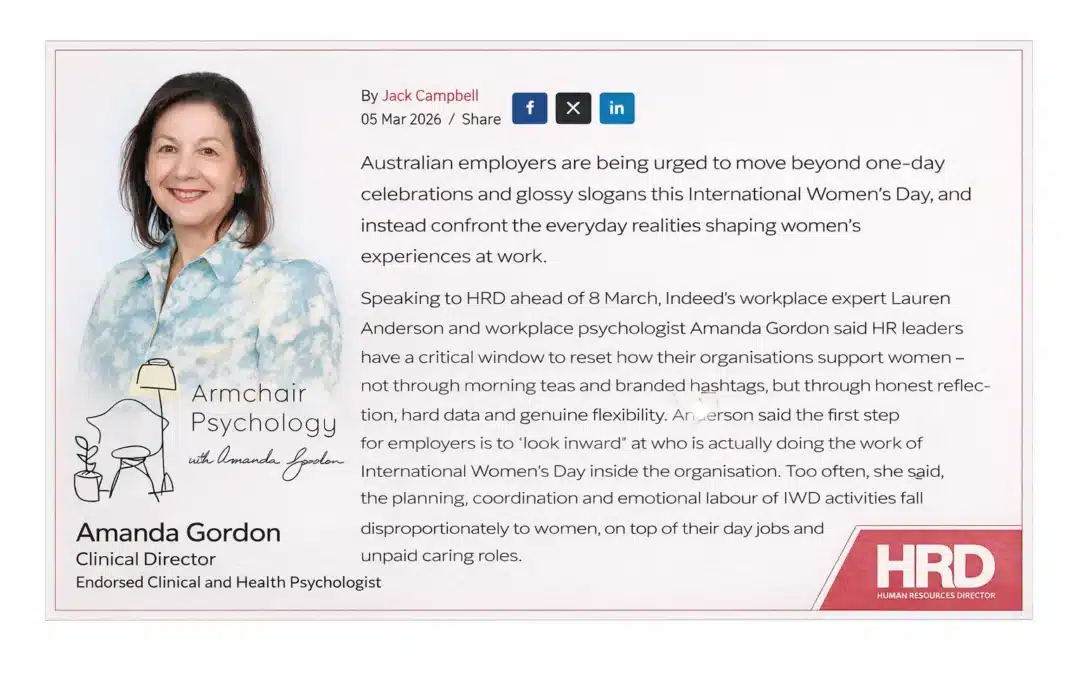
There is stress in the Australian workplace. I was recently interviewed as part of a Herald Sun piece titled 'Alarming trend: How Aussie workers are silently struggling revealed.' Here is a brief excerpt: Australians are “quietly cracking’’ at work, as cost-of-living...

Working as a team to increase cohesiveness

Working as a team to increase cohesiveness

In my time working at Armchair Psychology, it has become evident to me that each of the Psychologist team members have varied and valuable skill sets.  No one person can claim to know everything about everything, so it is helpful for me to know that wherever...

Juggling Family & Work in High-Pressure Roles

Juggling Family & Work in High-Pressure Roles

Juggling Family & Work in High-Pressure Roles Can you can close million-dollar deals, but somehow become defeated by homework battles? There are skills that don't translate. Control. Efficiency. Measurable outcomes. These make you brilliant at work. At home? They...

Mental Health for High-Performing Professionals

Mental Health for High-Performing Professionals

Mental Health for High-Performing Professionals You didn't climb to where you are by accident. But here's what nobody tells you: the same drive that fuels your success can quietly sabotage your well being. When does your success becomes a burden? When you set...

Use Your Remaining Medicare Sessions Before Year End

Use Your Remaining Medicare Sessions Before Year End

Use Your Remaining Medicare Sessions Before Year End In Australia, mental health care is a right, not a privilege. The Medicare Better Access program allows eligible adults to receive subsidised psychological therapy each calendar year. These sessions reset every 1...

End of Year Burnout: When Achievement Becomes Your Enemy

End of Year Burnout: When Achievement Becomes Your Enemy

End of Year Burnout: When Achievement Becomes Your Enemy As December approaches, calendars fill with project deadlines, client demands and social events. High‑performing professionals are no strangers to stress, but the end‑of‑year crunch can push even the most...

Therapist vs Psychologist: What’s the Difference (in Australia)?

Therapist vs Psychologist: What’s the Difference (in Australia)?

Therapist vs Psychologist: What’s the Difference (in Australia)? Many Australians are confused about whether to see a therapist or a psychologist when they need support. This short guide explains the differences so you can choose the right professional for your needs....

You Are Not Alone: Why Moods Can Really Be Upsetting for Teens

You Are Not Alone: Why Moods Can Really Be Upsetting for Teens

You Are Not Alone: Why Moods Can Really Be Upsetting for Teens I"Yesterday my 15-year-old was laughing with her friends. Today she won't come out of her room." A mum sat across from me last week, completely bewildered by her daughter's emotional rollercoaster.​ If...

Why Sydney Couples Are Choosing Therapy Before the Crisis Hits

Why Sydney Couples Are Choosing Therapy Before the Crisis Hits

Love in the Fast Lane: Why Sydney Couples Are Choosing Therapy Before the Crisis Hits The New Approach to Relationship Maintenance In the past year, I've noticed a shift in my practice at Armchair Psychology. Couples are arriving with a different energy. Instead of...

How Aussie workers are silently struggling revealed

How Aussie workers are silently struggling revealed

There is stress in the Australian workplace. I was recently interviewed as part of a Herald Sun piece titled 'Alarming trend: How Aussie workers are silently struggling revealed.' Here is a brief excerpt: Australians are “quietly cracking’’ at work, as cost-of-living...

Working as a team to increase cohesiveness

Working as a team to increase cohesiveness

In my time working at Armchair Psychology, it has become evident to me that each of the Psychologist team members have varied and valuable skill sets.  No one person can claim to know everything about everything, so it is helpful for me to know that wherever...

Recent Post
Juggling Family & Work in High-Pressure Roles

Juggling Family & Work in High-Pressure Roles

Juggling Family & Work in High-Pressure Roles Can you can close million-dollar deals, but somehow become defeated by homework battles? There are skills that don't translate. Control. Efficiency. Measurable outcomes. These make you brilliant at work. At home? They...

Mental Health for High-Performing Professionals

Mental Health for High-Performing Professionals

Mental Health for High-Performing Professionals You didn't climb to where you are by accident. But here's what nobody tells you: the same drive that fuels your success can quietly sabotage your well being. When does your success becomes a burden? When you set...

Use Your Remaining Medicare Sessions Before Year End

Use Your Remaining Medicare Sessions Before Year End

Use Your Remaining Medicare Sessions Before Year End In Australia, mental health care is a right, not a privilege. The Medicare Better Access program allows eligible adults to receive subsidised psychological therapy each calendar year. These sessions reset every 1...

End of Year Burnout: When Achievement Becomes Your Enemy

End of Year Burnout: When Achievement Becomes Your Enemy

End of Year Burnout: When Achievement Becomes Your Enemy As December approaches, calendars fill with project deadlines, client demands and social events. High‑performing professionals are no strangers to stress, but the end‑of‑year crunch can push even the most...

Therapist vs Psychologist: What’s the Difference (in Australia)?

Therapist vs Psychologist: What’s the Difference (in Australia)?

Therapist vs Psychologist: What’s the Difference (in Australia)? Many Australians are confused about whether to see a therapist or a psychologist when they need support. This short guide explains the differences so you can choose the right professional for your needs....

Categories
Our Services
Armchair Psychology